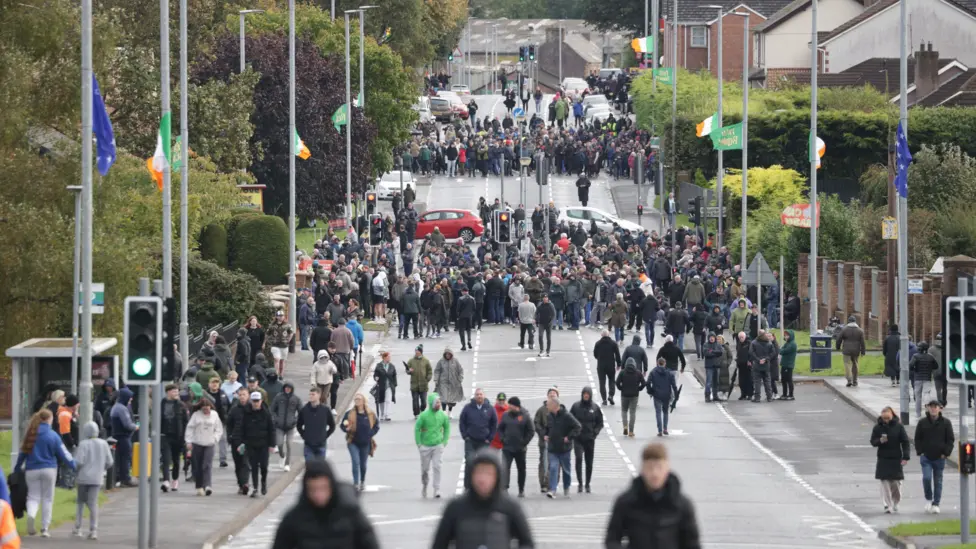
A long-running dispute over the Garvaghy Road in Portadown has reignited after the Parades Commission authorised a restricted procession of 35 Orange Order members along the road. After a series of court proceedings, the courts ultimately allowed the parade to proceed, but thousands of protesters gathered to prevent the men from completing their route. The protest involved senior Sinn Féin politicians, including First Minister Michelle O'Neill. The PSNI subsequently confirmed that a large-scale criminal investigation was under way into the unlawful protest. The dispute has now taken another extraordinary turn, with reports that three sirens have been installed along the Garvaghy Road to alert residents if another Orange Order march is attempted.
A group of just 35 members of the Orange Order were granted permission to walk along the Garvaghy Road in Portadown as part of a restricted procession from Drumcree Church.
The Parades Commission had imposed strict conditions on the procession. Only 35 people were permitted to take part, no supporters or bands were allowed, and the procession was subject to a specified time window.
The decision was challenged in court by residents. Although a High Court judge initially issued an injunction preventing the parade, the Court of Appeal overturned that decision. The Chief Justice said the High Court judge had "unfortunately erred in law". A subsequent application was also dismissed, leaving the 35 Orangemen legally entitled to proceed.
Despite the court decisions, thousands of people gathered on the Garvaghy Road and blocked the public highway in an attempt to prevent the procession.
The protest was described by reporting from the Irish Times as an illegal protest under Northern Ireland's parading legislation. Senior Sinn Féin figures, including Northern Ireland First Minister Michelle O'Neill and party president Mary Lou McDonald, were present at the protest.
The PSNI has since confirmed that a large-scale criminal investigation is under way into the unlawful protest. Chief Constable Jon Boutcher said that "mob rule" must not be allowed to prevail and that evidence gathering and the criminal justice process were being prioritised.
The controversy is particularly significant because the marchers were not attempting to hold an unrestricted parade. The permission granted by the Parades Commission was for only 35 members of the Orange Order, without bands or supporters.
The dispute nevertheless demonstrates how deeply contested Protestant and Orange cultural expression remains in parts of Northern Ireland. Garvaghy Road is a predominantly nationalist and Catholic area, while the Orange Order is a Protestant fraternal organisation. The route has been one of Northern Ireland's most contentious parade disputes since the 1990s.
For critics of the protest, the central issue is therefore not simply whether residents dislike the parade. It is whether a legally authorised expression of Protestant and unionist culture can be physically prevented from using a public road after the courts have determined that the procession may proceed.
That raises a difficult question about equal treatment and sectarianism.
Northern Ireland's history means that communities have legitimate concerns about provocative behaviour, historical grievances and the potential for disorder. But those concerns do not remove the need to respect the law. If one community is permitted to exercise a lawful right while another community is able to prevent that right through mass physical obstruction, questions inevitably arise about whether cultural and religious expression is being treated equally.
The involvement of senior political figures makes the situation still more serious.
A First Minister has a particular responsibility to uphold public confidence in Northern Ireland's institutions and the rule of law. Michelle O'Neill has defended her decision to stand with the Garvaghy Road residents, saying she had chosen to support them and would continue to do so.
The issue is therefore bigger than one parade.
It concerns whether Northern Ireland can accommodate competing British, Irish, Protestant, Catholic, nationalist and unionist identities while applying the law equally to everyone.
The latest development adds another unusual dimension. Reports published on 4 October say that three sirens have been installed along the Garvaghy Road, reportedly to alert residents if an Orange Order march is attempted again.
The symbolism is difficult to ignore.
A peaceful, lawful procession by 35 people has become the focus of a major political and community confrontation, with thousands mobilising to stop it, senior politicians becoming involved, police launching a criminal investigation and residents reportedly installing warning sirens.
Whatever one's view of the Orange Order or the history of Drumcree, the fundamental principle should be straightforward: lawful rights cannot depend upon whether the people exercising them belong to the "right" community.
For a society emerging from decades of sectarian conflict, that is a principle worth defending.
The Ireland Question: the law should protect people's rights regardless of whether they are Protestant, Catholic, nationalist or unionist.
Source: Reuters